Showing posts with label research. Show all posts

Sunday, May 3, 2015

Fool's Gold, and other pretty frauds. Part One.

Rock hunting, like so many other endeavors, is a kind of treasure hunt.  Whether we're looking for amethyst crystals or agate nodules or veins of serpentine or boulders of jade, we always head out with the hope of striking it rich.  That hope may be very faint, and we may have other objectives as well, such as seeing some great scenery or just enjoying the outdoors with friends, but the hope is still there.

Most of the time we don't hit that big score.  We come home tired and happy with whatever it was we did find, or we console ourselves on not finding anything this time but next time we certainly will.  Sometimes, of course, we do find something really fantastic, like that big brick of agate-veined red jasper I dug out of the ground at Brenda, Arizona or this agate nodule my husband picked up at Saddle Mountain, Arizona.  We were leaving the site, turning onto the road to head home, and he saw it out the truck window.  It was just perched on the top of the gravel heaped up by the road grader.


And yes, that's in inches.  It's almost 8 inches (20 cm) long and weighs well over 2 pounds.  The outer part is banded agate with a solid, not hollow, crystal center.


When we find it ourselves, we pretty much know it's the real thing, even if we don't know what real thing it is! 

Iron pyrite, commonly called fool's gold, is just one of the many natural "fakes" we may find, and probably the best-known.  It's not gold, of course, though it's metallic and shiny and kind of golden in color.  Mother Nature has fooled a lot of fools into thinking they'd scooped up a fortune when all they really had was a scoop of iron sulfide, also known as pyrite.  Some of those fools have then turned the trick on others, or at least tried to.

That's not to say iron pyrite is without value just because it's not gold.  Did you know marcasite jewelry, popular especially during the Victorian era but still made today, uses faceted iron pyrite for its glitter?  Although there is a mineral called marcasite that is also an iron sulfide like pyrite, its crystal structure makes it unsuitable for faceting.  So in steps iron pyrite, fool's gold, to fool us once again!

Pyrite itself, of course, can be pretty enough on its own to be collectible.  This is a fist-sized chunk I purchased for an absurdly small sum at one of the Quartzsite shows several years ago. 


This smaller piece -- it's about the size of a U.S. quarter -- is from a bag of rocks I purchased at Chicago's Museum of Science and Industry on a school field trip when I was in fifth grade.  (Yes, I'm a hoarder.  Yes, I really do remember buying that bag of rocks on our fifth grade field trip.)


The location of Navajún, Spain, produces exquisite cubic crystals of iron pyrite.  The specimen pictured below was a gift to me from Rob, the son-in-law of my dear friends Jan and Alida from the Netherlands.  The pyrite crystals from Navajún are so bright and shiny that you can easily see the wood grain of my table reflected in the lower face of the leftmost crystal in this sample.  These crystals have not been polished in any way; they're still in the matrix in which they formed.


Pyrite occurs with other minerals.  It's what gives this brilliant blue lapis lazuli its glitter.


But iron pyrite still isn't gold.  When it's identified correctly and used correctly, collected and bought and sold as what it really is, it's not a fake and it's not a fraud.  The people who claim it's something else are the fakes and frauds.  Sadly, there are a lot of those people in the rock/gem/mineral businesses.  Even though most of us are up front and honest about what we do, there are enough bad eggs out there to give us all a bad name.

What can you do to protect yourself against fakes and frauds?  The best way is to educate yourself.  You'll not only learn which rocks and minerals are the real thing, but you'll also learn which people to trust and which not to.

Fool's gold is one of those frauds most of us encountered at a very young age, and it's been around a lot longer than all of us.  There are new frauds, new fakes, new scams cropping up just about every day.  Some of them are really almost laughable, but others are very pretty and like iron pyrite need to be appreciated for what they are rather than for what someone is trying to make them be.

Saturday, March 28, 2015

Really Neat Rocks . . . from the Sea!

The past couple of months have been very, very busy for me, which is why I haven't written here.  It's not that I haven't been writing; it's just that I haven't been writing here.  Today that changes.


For one thing, I have ordered a brand new rock saw.  My old faithful Lortone was extremely used when we bought it 25 years ago, and it has given excellent service.  It has cut many, many rocks, been through many blades, a new motor, and I don't know what else.  Eventually, the table has worn out and the bottom is full of little holes.   It's just time to replace it.  Expected arrival of the brand new stainless steel Lortone Unit is Tuesday, and I'm beside myself with anticipation.


Part of the reason for the new saw is that I simply have all these really neat rocks around and I need to do something with them.  So, what's this particular blog going to be about?  Agates?  Jaspers?  Rainbow obsidian?


Nope.  Sea shells.


Sea shells?  Sea shells?

There is, of course, a story behind them, and that's why they're here today.

I love natural things, like stone and wood.  My photo albums are filled with pictures of clouds and rain and storms and mountains, trees and flowers and running water.  Because I lived the first 37 years of my life in the Midwest and the past 30 in Arizona, sea shells have never been an easily or readily acquired material, but that doesn't mean they don't attract my attention.

On one particular day, they really caught my attention.


Sunday, 19 October 1969, was a warm sunny day in Norfolk, Virginia.  A gorgeous day for heading to the beach at Ocean View.  My husband was in the Navy, stationed in Norfolk, and we didn't have a lot of money for entertainment, but an afternoon at the beach didn't cost anything.

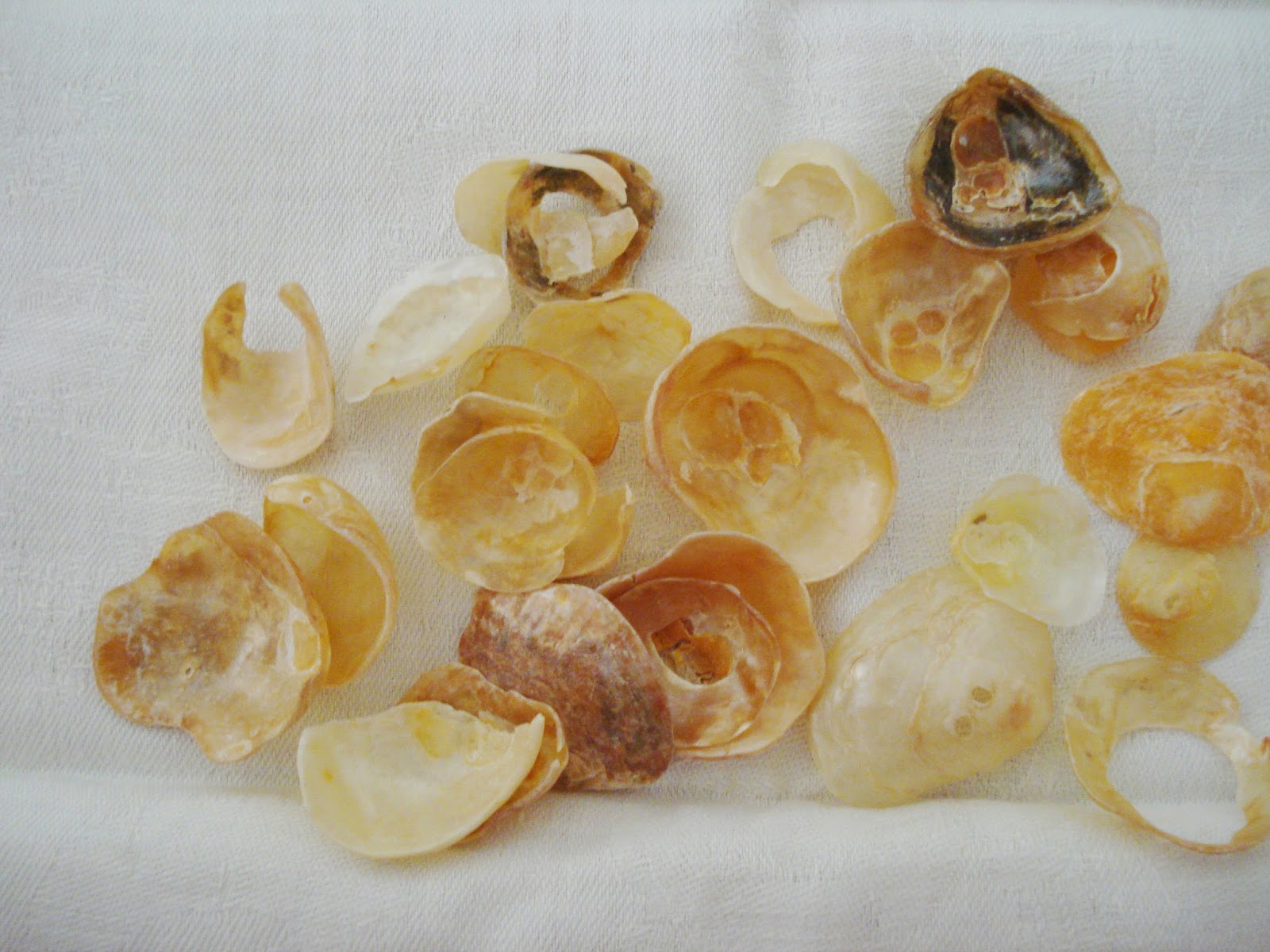
The sand was littered with lovely shells, a kind I'd never seen before.  Thin, translucent, in colors from a creamy pearl ivory to a rich golden orange, they seemed to be just about everywhere.  He found an old cigar box on the beach and I began picking up shells.

The big crafting rage in those days was poured resin casting, and we had it in mind to make a round tabletop.  The shells would make excellent material for such a project.  It never happened.  I kept the shells, but we never had the spare cash to buy the resin or the mold to pour it in.  We moved back to Indiana, where sea shells were only souvenirs from somewhere else.  And then, so many years later, we moved to Arizona and its really neat rocks.

But of course the sea shells came with me.  They've sat in two small boxes in my desk drawer for years now.  Once in a while I take them out to look at and wonder what kind of jewelry I could make from them.  Nothing has yet quite come to mind, although there are possibilities percolating in my brain.

Last night those two small boxes kind of came alive with whisperings from those shells.  It occurred to me that I didn't even know what kind of shells they were, though of course I knew exactly when and where I had found them.  So I threw up a question post on Etsy.com.  This morning I had my answer.  Thank you so much, Jackie Locantore!

They're called "Jingle Shells."

http://www.mitchellspublications.com/guides/shells/articles/0001/

So named because a handful of these thin, translucent clamshell halves make a jingling sound when shaken together, Jingle Shells (Anomia simplex) are sometimes found as far north as the coast of Nova Scotia, and all the way down south to Brazil.
Well, now that I know what they are, I suppose I ought to figure out something to do with them!